Home is where you long to be. As the saying goes, home is where the heart is.
Home is landscape. It is a sense of place.
Home is being with family and friends. It is unconditional love.
Home is beauty. It is whatever stirs the heart.
Home is wonder. It is whatever intrigues the mind.

Wednesday, March 30, 2011

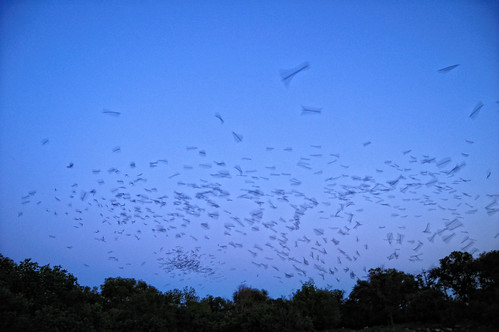
The Bat Vortex

The Bat Vortex by Joe Rocchio
The Bat Vortex, a photo by Joe Rocchio on Flickr.
Via Flickr:
During spring and summer evenings, 20 million bats emerge from Bracken Cave (north of San Antonio, TX). They fly out of the cave in a spiral flight pattern. This bat colony is the largest congregation of mammals in the world. Watching them emerge is an absolutely amazing experience. Kudos to Bat Conservation International for protecting this and other bat colonies.

www.batcon.org/index.php/get-involved/visit-a-bat-locatio...
Friday, April 16, 2010

Inverted Stream

DSC_0634_p

Eskers are the result of sand and gravels deposited by streams that flowed within or under glaciers. Although its hard to tell in this photo, the vegetation on the esker differs from adjacent areas because of the esker's coarse soils. This particular esker is supporting a rare plant community (threetip sagebrush/bluebunch wheatgrass).

Coulee Evening

DSC_0397_p

Embedded on a ledge within Moses Coulee, is Whisper Lake. The home base for The Nature Conservancy's Moses Coulee Preserve.

Lichen Diversity

DSC_0653_p

I'm not a lichenologist, so I do not know their names, but I counted what looked like to me nearly 10 different species on this rock. They all had their own beautiful shapes and colors.

Carex flava

IMG_2596_p

Yellow sedge (Carex flava), a rare sedge in Washington, was growing in a calcareous fen in northeastern Washington.

Ponderosa Blues

IMG_1608_p

Dead ponderosa pine (Pinus ponderosa) along the foothills of the eastern Cascade Range in Washington.

Palouse Beetle

IMG_0990_p

Not sure of the name of this little beetle, but I came across it in the Palouse prairie of eastern Washington.

I’ve Spotted a Snack

IMG_0105_p

This bull snake never actually took a bite, but it definitely considered snacking on this spider.

Wednesday, April 14, 2010

Isolated

IMG_1200_p

Steptoe Butte supports a lonely, isolated chunk of native vegetation in a sea of agriculture. Steptoe Butte is essentially the top of an old mountain that has been partially buried by the thick loess soils that make the Palouse region such a productive agricultural area---an unfortunate fact for the native prairie ecosystem.

Shooting Star

IMG_2812_p

White variant of Dodecatheon conjugens.

Aridland Horizons

DSC_0552_gp2

Shrub steppe of eastern Washington.

Coulee Country

IMG_0309_p

The Scablands of eastern Washington is an amazing landscape created by massive, torrential floods that occurred during Pleistocene glaciation.

End of the Line

IMG_2640_p

Sunday, April 11, 2010

Sullivan Lake, Washington

IMG_2754_p2

Bluebunch Perspective

DSC_0644_p

Skin of the Earth

IMG_1130_p

Took this photo at Kahlotus Ridgetop Natural Area Preserve in eastern Washington. The area had burned a few weeks prior but the 'biological soil crust' (a combination of organisms that can include cynobacteria, mosses, lichen, and fungi) was still as beautiful as ever. Soil crust are very important to many arid ecosystems as they decrease erosion, affect water infiltration, provide nutrients, and can affect seed germination.

The Dichotomy of the Palouse

IMG_0941_p

The Palouse region of southeastern Washington once supported a vast stretch of grassland known as the Palouse prairie. This grassland is now one of the most endangered ecosystems in North America. Because of its fertile soil, the Palouse has been converted to agriculture. The foreground of this image shows native Palouse prairie (what the Palouse used to look like) while the background shows what 99% of this region looks like today---a vast region of wheat, peas, and lentils.  Still beautiful, but not quite the same.

I See You

IMG_0498_p

Short-horned lizard (Phrynosoma douglassii) skittering through shrub steppe in eastern Washington.

Prairie Star

IMG_1048_p

Prairie star (Lithophragma parviflora) is a common beauty in eastern Washington and the rare prairies of western Washington.

Thursday, April 8, 2010

Forest Glow

capitolforest_20100215_2876_DSC_4479

Capitol State Forest, Olympia, Washington.

South Park Sky

P8060027

Looking across South Park toward the Mosquito Range. Southern Rocky Mountains, Colorado.

Hoosier Giants

DSC_1107

Large black oaks (Quercus velutina) at Hoosier Prairie Nature Preserve, Griffith, Indiana. Managed by Indiana Department of Natural Resources and National Park Service (a unit of Indiana Dunes National Lakeshore). Black oak savannas once covered much of northwest Indiana but are now very rare due to conversion to agriculture and development.

Daggerpod Display

IMG_2806_p

Daggerpod (Phoenicaulis cheiranthoides) is found in the shrub steppe habitat of eastern Washington and similar habitats of western North America.

Selkirk Vista

IMG_2546_p

Looking northeast toward the Salmo-Priest Wilderness Area of extreme northeast Washington.

Mountain Hemlock Forest

IMG_2322_p

Higher elevation forests near the crest of the Cascade Mountains are often dominated by mountain hemlock (Tsuga mertensiana).